i was recently asked for an email with my suggestions on books about africa and this is what i came up with so i figured it might be useful to someone so i am also posting it here.
here are some of my favourite books about africa:
The Zanzibar Chest (Aidan Hartley) - memoir about life as a foreign correspondent in Africa and that whole post colonial guilt thing.
Sweetness in the Belly (Camilla Gibb) - fiction about a white woman who grows up in Muslim Ethiopia, amazing read.
Half of a Yellow Sun (Chimamanda Ngozi Adichie) - fiction set during the Baifran war in Nigeria, awesome and based on a lot of real events.
My Traitor's Heart (Rian Malan) - memoir of an Afrikaaner who fought against apartheid in South Africa, truly explores the white guilt and the issue of Africanness, I think you'd like it a lot.
In the Footsteps of Mr Kurtz (Michela Wrong) - journalist writes about Mobutu and his rule in the DRC, the one I was telling you about. Tough to get through at times, but you'll learn a lot about why the country remains effed to this day.
We Wish to Inform you That Tomorrow We Will be Killed With Our Families (Philip Gourevitch) - excellent account of the genocide in Rwanda and the role of the international community in prolonging the killings.
Shake Hands With the Devil (Romeo Dallaire) - the book that the commander of UN peacekeepers in Rwanda during the genocide wrote about his experience and frustrations with the UN system and watching people die, also a bit tough at times, but there is a glossary that always helps!
Don't Let's Go To the Dogs Tonight (Alexandra Fuller) - memoir of a poor, white Zimbabwean family, so interesting and an easy read.
Tick Bite Fever (David Bennun) - funny memoir of growing up white in Africa. Not fantastic, but an easy read.
Swahili For the Broken Hearted (Peter Moore) - I don't love his writing, but he did a trip through Africa riding solely on public transport and wrote about it, so there are some gems in amongst the other bits.
A Sunday at the Pool in Kigali (Gil Courtemanche) - fiction (but probably mostly true) about the expats during the genocide in Rwanda. The story will make you cry, but I loved the raw writing of the French Canadian author.
Acts of Faith (Philip Caputo) - an awesome novel about the war in Southern Sudan, the community of pilots, how the UN capitulates war, and the scandals of it all, a really great read and I know from my pilot friends that the story is true and the names were just changed.
Emma's War (Deborah Scroggins) - non fiction, about a British woman who rocks up in Southern Sudan in the middle of a civil war, marries one of the rebel war lords, becomes his second wife, and then actively participates in the war, alienating most people she knows. I also think you'd really like this as it shows the naivity and sincerity of foreign aid workers and those who feel th eneed to 'save' Africa. One of the characters in the book above is based on her, undoubtedly.
You asked for it, and there you have it! I surprised myself with how many books I could pull out of my head and I clearly could start my own post-colonial African literature course...
What can I say - I didn't have a TV for a number of years... nothing like reading a book when you are in bed with a hangover in Nairobi.
Showing posts with label kigali. Show all posts
Showing posts with label kigali. Show all posts
Saturday, June 06, 2009


Monday, March 31, 2008
sick days
(march 28, 2008)
first of all, i am going to south africa in 3 weeks. 3 weeks! 21 days!
secondly, i am sick. again. what has happened to my immune system of steel? since i moved to kenya, i have been sick more often than i can count in my previous 26 years. this time it is a tuberculosis-type cough. i do not believe that i have tb, but i sound disgusting. and i am pretty sure my host in kigali gave it to me because i sound peculiarly like she did when she coughed up lungs.
i am sick on the coast of kenya. here i am beside the indian ocean surrounded by great italian food (did you know there is a little italy in kenya? there is, and it is full of perverts and old wrinkled up italians who are the equivalent of the canadian snow birds) and i have to be sick enough that after i finish my day of work i cannot even muster a walk on the beach! cripes.
to make this whole sickness feel worse, i am right now sitting in a conference room and it is 9:00am and i have no more than 6 of the people who are supposed to be attending my workshop today (out of a total of 30) that was to start at 8:30am. double cripes.
and, and! one man in my training told me yesterday that ‘in the african context, a commercial sex worker cannot be raped.’ grrrrrr....... i know many african women who vehemently disagree. but he felt the need to educate me on this fact, just so we were clear. i wanted to spit. on him. but i didn’t.
because then i was interviewed by 4 national newspapers and broadcast news stations. my only hope is that i did not sound ridiculous and that the shine off my forehead did not blind the viewers because this place is hot and i had to stand in the sun and melt while trying to sound intelligent. seriously, try that at home and tell me how easy it is.
the newspaper article can be found here
Tuesday, March 25, 2008
jenoside
(march 23, 2008)


i have been captivated by the rwandan genocide since reading romeo dallaire’s book Shake Hands With the Devil years ago. since then i’ve tracked down other authors and movies about the events of the 1994 genocide that attempt to provide information on the actions taken by government and social leaders with the goal of eradicating an entire ethnic group of people while at the same time laying bare the facts and details of an apathetic and inactive international community and united nations and the calamitous effects of that inaction.
i’ve visited 3 memorial sites in rwanda, the first being the Kigali Memorial Center, which is a fine example of a museum and is alone worth the trip to kigali. set in memorial gardens that have  been planted around mass graves and with a view of the city where the genocide began, it is a testament to those who were murdered, to those who survived, and to those who carried out acts to be considered no less than heroic. the country’s colonial and post-independence history, the genocide, and the effects are explained simply without losing the details in kinyarwanda and french and english.
 been planted around mass graves and with a view of the city where the genocide began, it is a testament to those who were murdered, to those who survived, and to those who carried out acts to be considered no less than heroic. the country’s colonial and post-independence history, the genocide, and the effects are explained simply without losing the details in kinyarwanda and french and english.
i was struck how the memorial seemed to be designed to appeal to rwandan and foreign visitors 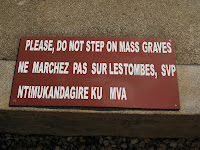 alike and it was extremely tasteful without diminishing the atrocities nor reducing the realities to something to be absorbed in an afternoon. it does an excellent job at allowing those who were not there to have a better understanding of what those 3 months were like and it honours those who were there while being unapologetic on the known causes and contributing factors that led to nearly 1 million people dead at their hands of their fellow countrymen, women, and children.
but if i thought the room containing the bones and clothing was disturbing, i was unprepared for what i would see and feel at the Nyamata and Ntarama memorial sites.
 alike and it was extremely tasteful without diminishing the atrocities nor reducing the realities to something to be absorbed in an afternoon. it does an excellent job at allowing those who were not there to have a better understanding of what those 3 months were like and it honours those who were there while being unapologetic on the known causes and contributing factors that led to nearly 1 million people dead at their hands of their fellow countrymen, women, and children.
but if i thought the room containing the bones and clothing was disturbing, i was unprepared for what i would see and feel at the Nyamata and Ntarama memorial sites.
both were catholic churches and both served as sites of mass murder when tutsis sought refuge in the only place they thought would be safe, which was utilised by the interahamwe to kill almost all of them inside the church walls. the skulls and larger bones like femurs have been collected and piled up as a memorial and reminder of what happened. some bones have visible hack marks from machetes and some have obvious holes in them. one still has a spear sticking out the top of it. some are small enough to be babies, who were apparently thrown against walls until they died.
more upsetting than the bones are the clothes hanging from the rafters of the church. they are filthy and still hold smells that bones cannot. the items people carried with them into the churches have also been kept – jerry cans, beans, school notebooks, mattresses... – and those things more than the bone make it real for me. that they came to escape the violence with the hope they’d survive. a children’s notebook carries with the belief that preceded the reality.
the man showing me around was there the day the interahamwe came into the church and began killi ng until there was no one left alive, but managed to escape. i felt in one moment an opportunistic tourist and the next, a member of a civilisation who should carry the weight of the consequences of doing nothing in the face of hatred. those working in the memorials are intimately and forever connected to their reason for existing and have lost more than i can begin to imagine and yet they continue telling their stories and the stories of the thousands who were killed so we can know what happened. they walk in every day and see the skulls of their family and community members who did not survive and talk about the horrors they witnessed.
 ng until there was no one left alive, but managed to escape. i felt in one moment an opportunistic tourist and the next, a member of a civilisation who should carry the weight of the consequences of doing nothing in the face of hatred. those working in the memorials are intimately and forever connected to their reason for existing and have lost more than i can begin to imagine and yet they continue telling their stories and the stories of the thousands who were killed so we can know what happened. they walk in every day and see the skulls of their family and community members who did not survive and talk about the horrors they witnessed.
bricks stained with blood, bullet holes in an altar, a machete left behind by a killer, thousands upon thousands of skulls, hair and bones scattered amidst the rubble of a sunday school, rosary beads, smoke stains from fires that burned people alive, holes in brick walls from grenades, coffins of newly found bodies to be buried this year during the upcoming national week of memorial.
i’ll keep reading about the genocide and i will still be utterly confused when attempting to understand not only why but how. just that now it will be so frighteningly real.
impressions of my new favourite african capital
(march 23, 2008)


my first impressions of rwanda are that it is indeed the land of a thousand hills and that i’ve never been to a country as green (although even with my magnetism to irish men, i’ve yet to make it to ireland, but i bet rwanda give it a run for it’s green money).
when i first arrived, i couldn’t help by wonder though, who was who, was here during the genocide, and who has returned since. i couldn’t help but look at people’s faces and wonder if they were hutus or tutsis (or h’s and t’s as i’ve heard people say because today, they are all to be considered rwandans). i wondered how exhausting it must feel to be constantly confronted with the country’s ethnic division and history. then i realised that you just get on with it. because the country’s present and future are just as fascinating as its history.
kigali is thus far the cleanest and most beautiful african city i have visited (usurping arusha, my previous favourite) and it is incredibly photogenic. the entire city spills over and up and down the hills and houses are built right into the sides of the hills that give this country its name.
as an expat in this whole thing we call development, i was always ask myself if i could live here, where ever ‘here’ is at that moment. my answer in kigali so far is yes. although it might become monotonous – the landscape, the limited amount of entertainment options, and the greyness that sets into these hills on overcast days. but the city is safe, using plastic bags is against the law, the roads make sense, and i’ve located a coffeehouse that rivals its kenyan counterparts (being nairobi java house and dormans, but of course) with its rwandan twist on the concept made famous and profitable by starbucks.
as in kenya, a photo of the current president graces the walls of all business establishments in rwanda. but unlike kenya, people here seem to revere their leader, paul kagame, and as far as i can tell, i would if i were rwandan. i think i still do even though i am not.
keep your eye on rwanda, i think this place will continue to capture an audience and not just for their gorillas. oh, but the gorillas...!
Saturday, March 22, 2008
le pays des milles collines
the country of a thousand hills is very hilly. and very green. and very friendly. and very orderly. and very different than nairobi.
i have been here only 3 days and have been enjoying what rwanda has to offer, which includes good cheese, good coffee, good museums, good hiking (gorillas!), and good roads.
at the moment, i am avoiding the monsoon outside as i wait for my bus to depart from ruhengeri back to kigali and dreaming of a bathtub full of hot water and a cup of tea after a very uphill hike to see some gorillas this morning. i am also at this moment wishing i spoke more french and wishing i was a millionaire and could just hire someone to drive me in a very comfy car back to the city and then spend the night in a swank hotel while i process and recuperate from the last few days.
pictures and more stories to follow...
i have been here only 3 days and have been enjoying what rwanda has to offer, which includes good cheese, good coffee, good museums, good hiking (gorillas!), and good roads.
at the moment, i am avoiding the monsoon outside as i wait for my bus to depart from ruhengeri back to kigali and dreaming of a bathtub full of hot water and a cup of tea after a very uphill hike to see some gorillas this morning. i am also at this moment wishing i spoke more french and wishing i was a millionaire and could just hire someone to drive me in a very comfy car back to the city and then spend the night in a swank hotel while i process and recuperate from the last few days.
pictures and more stories to follow...
Subscribe to:
Posts (Atom)